LCNN partners with the Children & Nature Network’s Nature Everywhere program for Ripple Effect Mapping 2025!
Setting the stage…..where we have been:
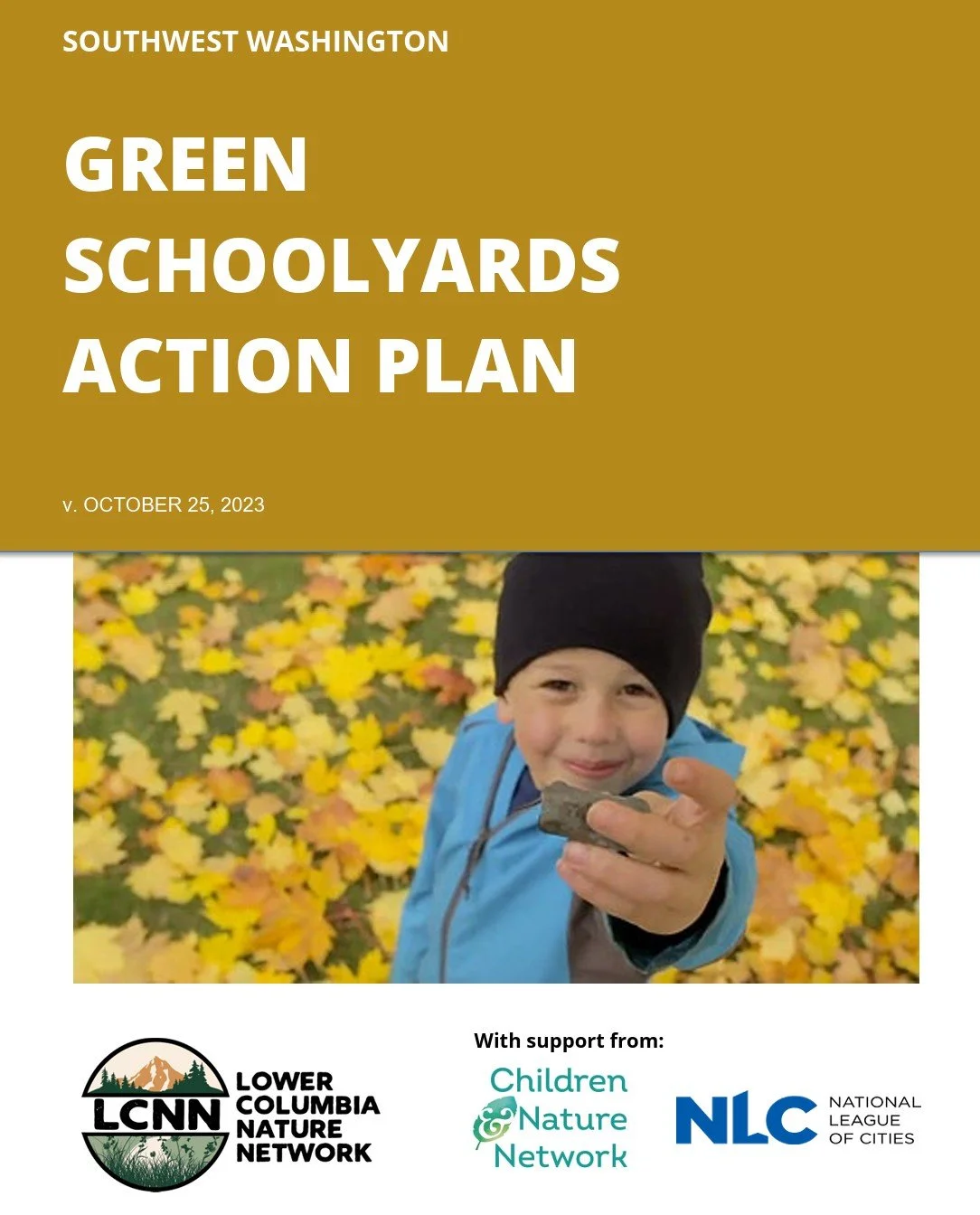
The Lower Columbia Nature Network partnered with the Children & Nature Network and National League of Cities for the 2021-2023 cohort to bring more equitable access to nature for our school communities across southwest Washington.
The Cities Connecting Children to Nature (now called Nature Everywhere Communities) work is a Systems Change approach to creating a movement and building support across the communities to provide equitable access to nature. This work involves not just schools, but local cities and counties, as well as various partners throughout the community. The work identifies opportunities and mutually aligned goals to support healthy communities using Green Schoolyards as a unifying approach. It goes beyond commonly held beliefs and explores new approaches to support creating safe, welcoming and equitable campuses that enhance learning, play and wellness. Join us as we green southwest Washington!
Learn more about the CCCN work at www.lowercolumbianaturenetwork.org/green-schoolyards
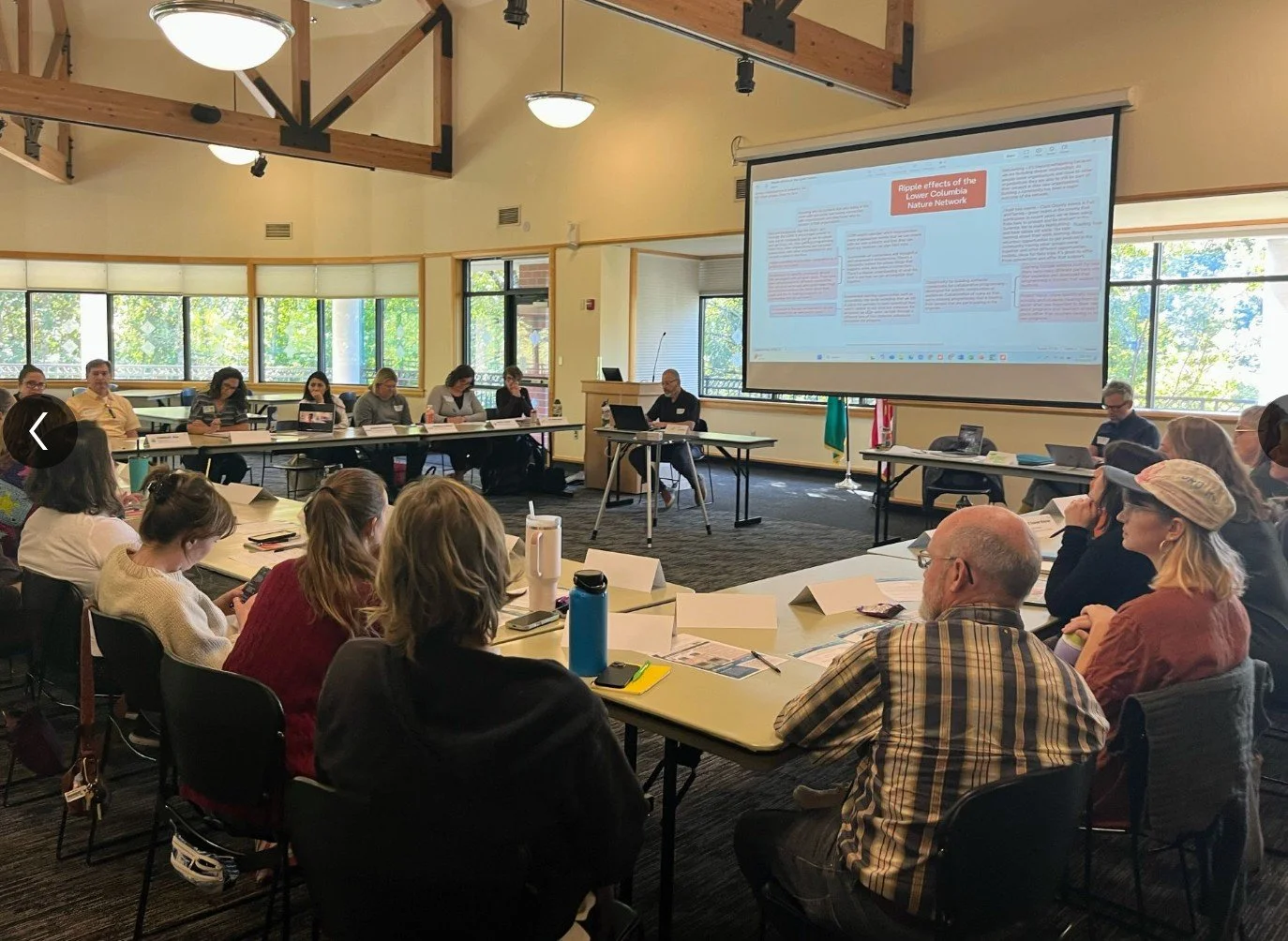
LCNN convenes Ripple Effect Mapping in fall 2025 with partner agencies & stakeholders
The Ripple Effect Mapping evaluation tool is used to identify the broad range of personal, organizational, and network impacts of the Lower Columbia Nature Network in the southwest Washington region. On September 25, 2025, a group of 28 people from LCNN member organizations came together for a Ripple Effect Mapping session at the City of Vancouver’s Water Resources Education Center. The session was facilitated by Dr. Erin Allaman, Director of Learning & Evaluation and Co-Director of Research for the Children & Nature Network, and Dr. Scott Chazdon, a consultant with expertise in Ripple Effect Mapping.
Overview. At the beginning of the session, participants interviewed each other in groups of three using Appreciative Inquiry questions focused on the network's impacts. Six core impact themes emerged from the interview process. In addition, towards the end of the REM session, participants discussed some of the challenges they have faced in their work as part of LCCN. These challenges were added as a seventh theme. Read below for a summary of the REM findings:
Convening a network community to increase equitable access to nature
LCNN has established connections across various agencies, nonprofits, and community groups, resulting in collaborative projects, funding opportunities, and outreach activities that engage families and underserved communities. The network also provides opportunities for professional growth, inspiration, and joy in the work, especially for educators and program leaders. Overall, the network serves as a critical connective tissue, supporting collective efforts, problem-solving, and sustained collaboration in the region.
Building collaborative programs based on authentic connections
The most robust theme from the REM session concerned the broad range of collaborative programs that have been developed or enhanced through the LCNN. Participants were insistent that this theme title include the word “authentic” to describe the manner in which connections have been developed by network members in response to the lived experiences of community members. Through the network, member organizations have discovered that two or more organizations working together can create a more effective way to create opportunities to offer services and reach communities.
Coordinating and updating plans, policies, and practices to promote equitable access to nature
Relationship building and collaboration through LCNN have led to a variety of systems changes. LCNN and its member organizations have created or updated a wide range of policies, plans, and practices that promote equitable access to nature and ensure that this work will continue into the future. Organizations such as the City of Vancouver and Clark County have aligned their climate action initiatives, including comprehensive plans that prioritize access to parks and green spaces. The SW WA Green Schoolyards Plan has emerged as a pivotal project that reflects this collaboration, integrating climate action goals with educational pursuits. This comprehensive approach has allowed multiple stakeholders to identify overlaps in their plans, enhancing the overall effectiveness of their environmental initiatives.
Creating a culture of opportunities for a green workforce and future stewards
LCNN’s efforts have established a supportive culture that encourages young professionals and students to join the green workforce, emphasizing networking opportunities, mentoring, and professional development. Community-driven projects such as ProjectVOICE, Clark County Green School Student Summits and Portland-Vancouver Canopy Collective have engaged youth in important discussions about climate and environmental issues. These initiatives enable collaborative efforts in green career development, encompassing teacher training, classroom coordination, and hands-on projects such as campus planting and stewardship, ultimately aiming for a sustainable impact in both education and local ecosystems.
Supporting resilient resource sharing to keep this work going
The LCNN has fostered a strong sense of community among partner organizations, facilitating a collaborative approach to overcoming funding challenges. When faced with potential funding cuts, members rally to explore alternative financial sources, ensuring that essential programs continue. This network not only provides financial assistance but also enhances programming opportunities by leveraging the diverse expertise and broad range of activities represented within the community. By sharing knowledge and resources, participants can identify gaps, assess needs, and explore collaborative solutions to various challenges.
Facilitating and amplifying communication to create a culture of accessible nature
LCNN has enhanced communication and fostered a culture of accessibility through its website and community events calendar. The calendar compiles activities from various organizations, making it easier for community members, such as teachers, to plan field trips and find nature events for children. The website and calendar have kept network organizations connected with each other as well as serving as LCNN’s forward face to the community.
Challenges moving forward
Towards the end of the Executive Committee Ripple Effect Mapping session, the facilitators asked participants to describe some of the challenges they have faced in their participation in LCNN. Participants noted several interconnected challenges that organizations face when working to foster community engagement and access to nature. One broad theme was about sustaining political and financial support for this work. Several participants described organizational challenges arising in LCNN, including an ongoing challenge to promote equity in access to natural spaces and activities, as well as in network participation.
In summary, the Lower Columbia Nature Network (LCNN) has cultivated a strong community that enhances equitable access to nature by fostering authentic relationships among diverse organizations, individuals, and agencies in the region. Through face-to-face interactions and networking, members have developed deeper connections that transcend organizational boundaries, allowing for collaboration on shared projects, funding opportunities, and program development. This collaborative spirit has led to successful initiatives such as Green Schoolyards, accessibility assessments, and community engagement programs that bring nature to underserved communities. However, the network also faces challenges such as funding disparities, maintaining representation, and addressing systemic barriers to access to nature. Effectively reaching underserved populations to address broad community concerns will require ongoing innovation and potentially new strategies for inclusion of all community representatives in the network.
Learn more about the Nature Everywhere Communities across the U.S. and how communities are making accessible nature and open spaces a priority for healthy kids and families, at www.childrenandnature.org/nature-everywhere-communities/
NEC RESOURCES FROM 2025
Nature in Early Childhood: A Toolkit - Nature Everywhere Communities
The Nature in Early Childhood Toolkit offers a structured, multi-layered approach to ensure that nature is fully integrated into early childhood education systems. It provides tools, case studies and implementation guides to help communities think through the various stages of implementation, from partnership building and workforce training to amplifying and sustaining efforts through policy change and funding. Explore the Toolkit.
Climate Resilience & Children's Nature Connection Toolkit - Nature Everywhere Communities
This Climate Resilience-Nature Connections Toolkit demonstrates how cities can pursue both goals of increasing climate resilience and fostering deeper connections to nature, simultaneously. Four proven strategies in this toolkit, Nature in Early Childhood, Green Schoolyards, Nature-Smart Libraries and Nature Exploration Areas, when combined with climate goals, create healthier, more resilient communities where children thrive and ecosystems are protected. Explore the Toolkit.
Nature Exploration Areas: A Toolkit - KABOOM!, with Children & Nature Network and National League of Cities
This toolkit was developed through a collaboration of three leading organizations dedicated to playspace equity and equitable access to nature: Children & Nature Network, National League of Cities, and KABOOM! It explores how Nature Exploration Areas can benefit communities and children. Download the Toolkit.
Nature-Smart Libraries Toolkit - Nature Everywhere Communities
This toolkit highlights innovative, Nature-Smart Library initiatives nationwide, showcasing how libraries can collaborate with cities, parks, and community partners to expand nature access. While many libraries lead individual efforts, this toolkit emphasizes system-wide strategies to ensure nature is accessible across entire communities. Explore the toolkit.